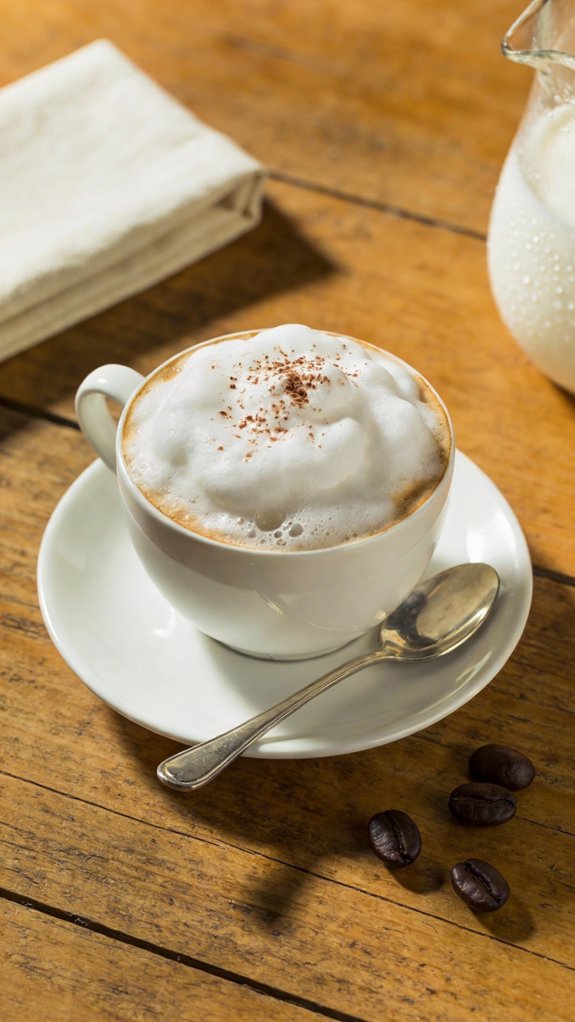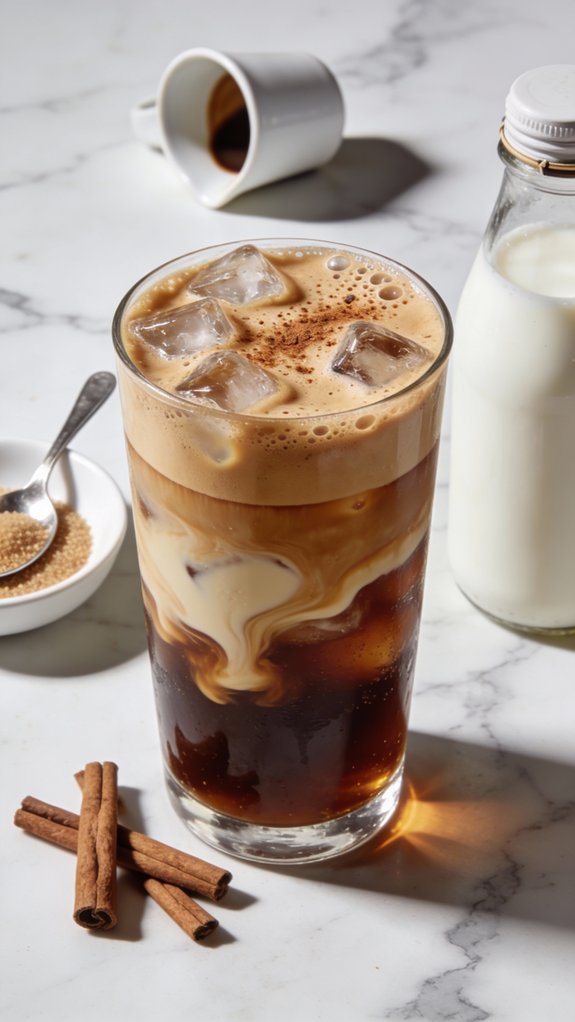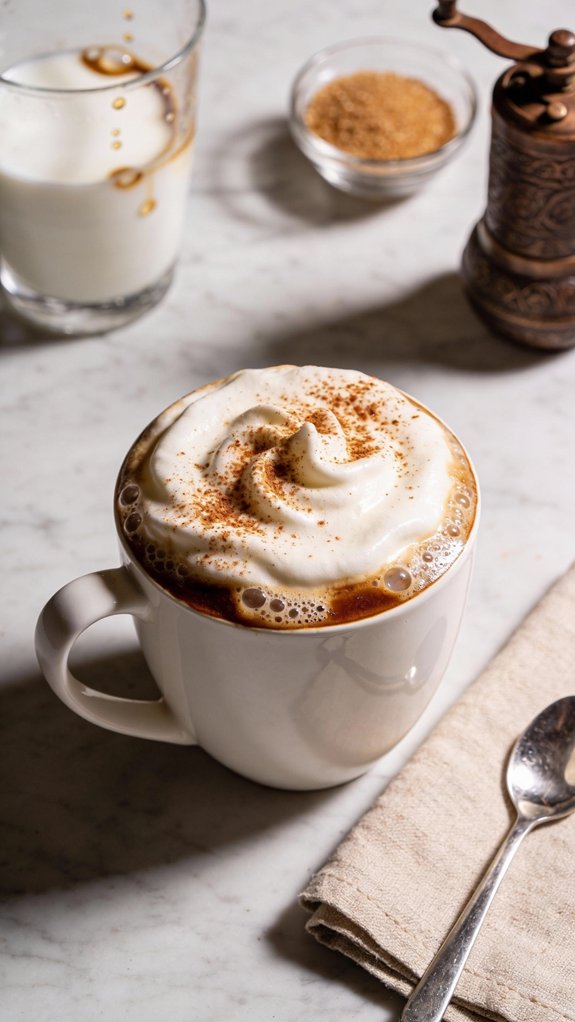
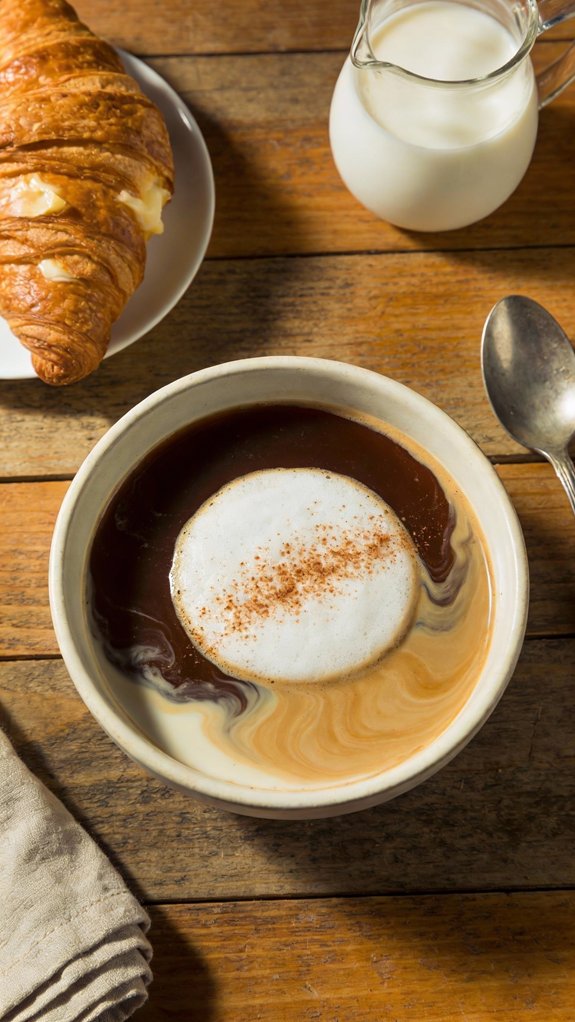
You probably didn’t know that café au lait was originally served in wide bowls, not cups, so French families could dunk their morning bread right in. I remember the first time I tried making it at home, thinking it’d be just another fancy coffee drink, but that equal parts ratio of strong coffee to steamed milk created something surprisingly different from my usual latte. There’s actually a specific technique that makes all the difference.
History
The first time I learned about café au lait’s origins, I was surprised to discover it wasn’t some fancy modern invention but a drink French households had been making for centuries.
French families started mixing their morning coffee with hot milk sometime in the 1600s, probably because it stretched their coffee supply and made it gentler on their stomachs.
I remember reading that the name literally translates to “coffee with milk,” which made me laugh at how straightforward the French were being.
Unlike the Italians who got all fancy with their espresso drinks, the French kept things simple and practical.
This became their everyday breakfast drink, served in those big bowls so you could dunk your bread without making a mess.
Recipe
Café au lait is a classic French coffee drink that combines equal parts strong brewed coffee and steamed milk, creating a smooth, balanced beverage with a velvety texture. Unlike a latte, which uses espresso, café au lait features drip coffee or French press coffee, resulting in a milder, less intense flavor that lets the natural sweetness of the milk shine through.
This drink is traditionally enjoyed at breakfast in France, often served in a wide, bowl-shaped cup perfect for dunking croissants or tartines. It works beautifully as a morning ritual or an afternoon pick-me-up, especially when you want something gentler than espresso-based drinks but more substantial than black coffee.
Ingredients
- 8 ounces freshly brewed strong coffee
- 8 ounces whole milk
- 1 tablespoon granulated sugar (optional)
- ½ teaspoon vanilla extract (optional)
- Pinch of ground cinnamon (optional)
Preparation
- Brew 8 ounces of coffee using your preferred method, making it slightly stronger than usual.
- Heat the milk in a small saucepan over medium heat until steaming and small bubbles form around the edges.
- Use a milk frother or whisk to vigorously froth the milk until foam forms on top.
- Stir the sugar, vanilla extract, and cinnamon (if using) into the hot coffee until dissolved.
- Pour the coffee and steamed milk simultaneously into a large cup or bowl, aiming for equal parts of each.
- Top with any foam from the frothed milk and serve immediately.
Tips and Variations
For a richer café au lait, substitute half-and-half or use oat milk or almond milk for dairy-free versions, though they won’t froth as well.
Adjust sweetness to taste or omit the sugar entirely for a more traditional French preparation. The vanilla and cinnamon can be skipped for a simpler version, or experiment with other spices like nutmeg or cardamom.
While you can make the coffee ahead of time and store it in an insulated carafe, this drink is best enjoyed fresh for ideal temperature and texture.
Shop Related Products

Superior Filtration: A solid filtration system in a coffee maker ensures a refined taste and robust flavor mouthfeel. Our 4-filter sieve system has an improved piston plate and 80 mesh filter that extracts the earthy, rich taste of residue-free coffee. This 1000 ml/34 Oz beaker makes 4 cups of creamier & tastier coffee.
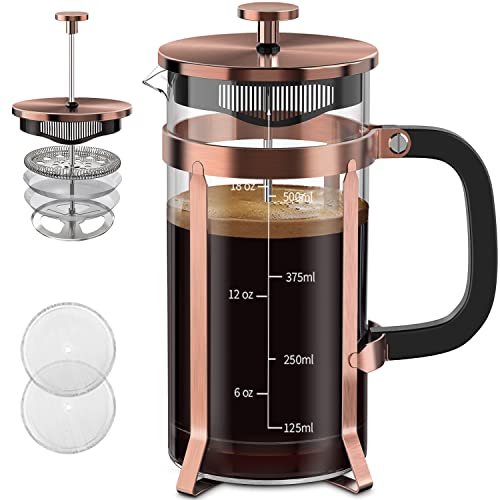
☕SUPER FILTERING - The quality of the coffee press greatly depends on the quality of the filter element. So the selection of springs is extremely important for the filtering of coffee powder, which will directly affect the taste of coffee. Our perforated plate could filter out big coffee grounds, and the 80 mesh filter could filter out tiny coffee ground
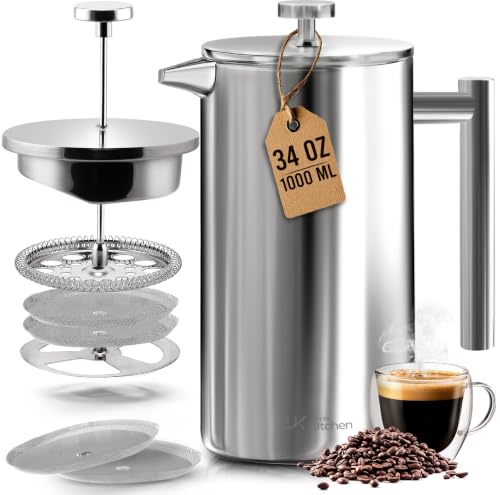
Double-Walled French Press: Make perfectly brewed coffee at home like a barista. The double-walled coffee press is heat resistant. Its solid construction will keep the drink hot for a long time.
Preparation Steps
Making café au lait isn’t complicated, but getting the timing right between your coffee and milk makes all the difference.
You’ll want to start brewing your coffee first since it takes the longest, then move on to heating and frothing your milk while the coffee finishes.
I usually add my sweeteners and spices to the hot coffee, then pour both liquids together into my favorite wide bowl or mug for that authentic French breakfast feel.
Shop Related Products

No Plastic Touching Food: Made with 304 stainless steel and food-grade silicone, our French press keeps all brewing surfaces plastic-free— no odor and no plastic particle into your coffee. Safe and worry-free

【EASY TO USE】Brew a cup of coffee in several minutes. The 51oz/1500ml french press makes the perfect cup of coffee. The french press coffee is the easiest to concentrate on the condition of the beans among the many devices. You can see the amount of foam (crema) after the coffee touches the water, and how the coffee floats on the water and slowly sinks

No Plastic Touching Food: Made with 304 stainless steel and food-grade silicone, our French press keeps all brewing surfaces plastic-free— no odor and no plastic particle into your coffee. Safe and worry-free
Step 1. Brew Strong Coffee Base
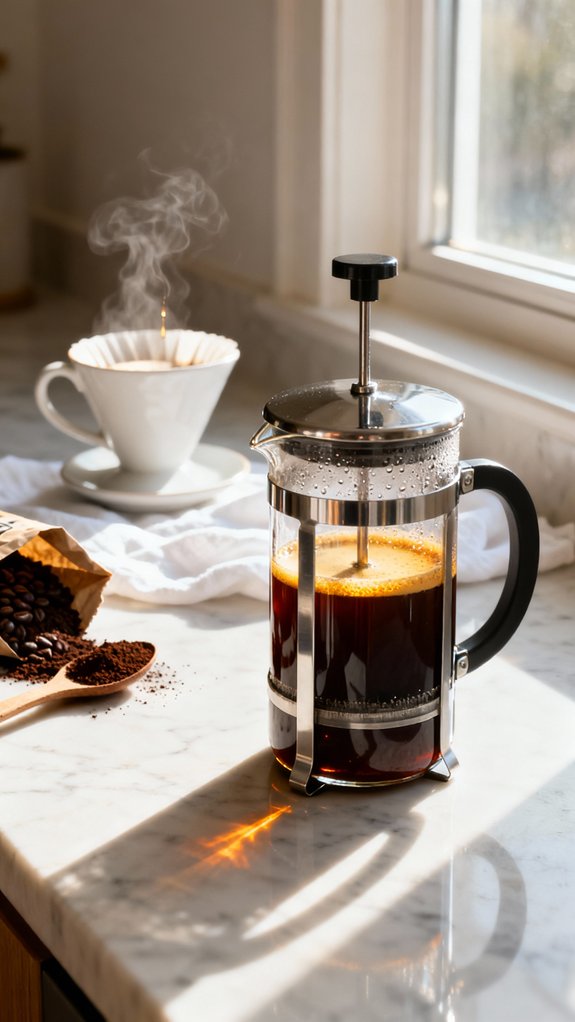
Since this drink relies on regular drip coffee rather than concentrated espresso, I always make my brew stronger than I normally would for drinking it black.
I use about 2 tablespoons of ground coffee per 6 ounces of water, which gives the coffee enough backbone to stand up to all that milk without disappearing completely. My French press works perfectly for this, though a drip machine set to a strong setting does the job too.
The key is letting the coffee brew fully—four minutes in a French press or a complete cycle in your drip maker. You want a robust, dark brew that smells bold and tastes assertive on its own, because once you add equal parts milk, that intensity mellows into something balanced and smooth.
Step 2. Heat and Froth Milk
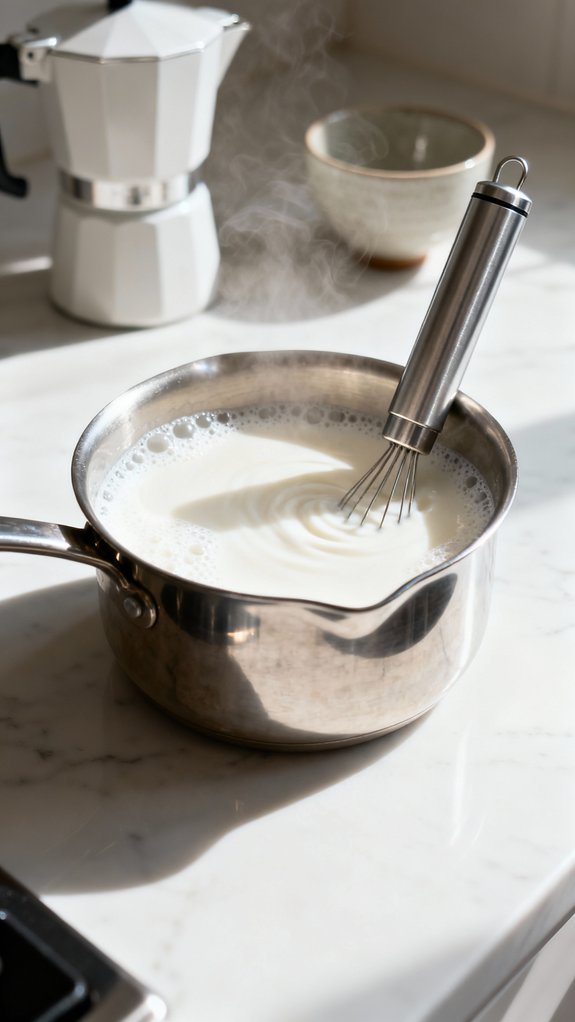
While the coffee finishes brewing, I pour my milk into a small saucepan and set it over medium heat, watching it carefully because milk can go from perfectly steamed to scalded in just seconds.
I’m looking for tiny bubbles around the edges, not a rolling boil. Once it’s steaming hot, I pull the pan off the burner and grab my handheld frother, working it up and down through the milk for about thirty seconds until I’ve got a nice foam on top.
If you don’t have a frother, a whisk works surprisingly well—you just need to whisk fast and aggressively, which honestly feels a bit ridiculous but gets the job done. The milk should roughly double in volume.
Step 3. Add Sweeteners and Spices
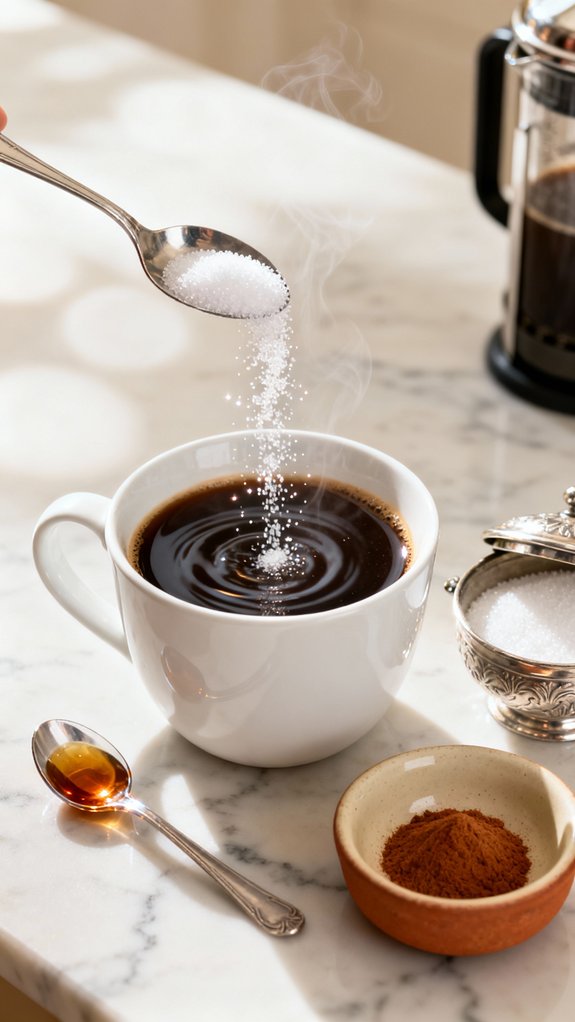
With the coffee still piping hot in the French press, I measure out a tablespoon of sugar and dump it straight into my mug, followed by half a teaspoon of vanilla extract and just a pinch of cinnamon.
I stir everything together with a spoon until the sugar dissolves completely, which takes maybe fifteen seconds of vigorous stirring.
The vanilla adds this subtle sweetness that reminds me of my grandmother’s kitchen on Sunday mornings, and the cinnamon gives off a warm, spicy aroma that cuts through the coffee’s bitterness without overpowering it.
You can skip these additions entirely if you want something more traditional, or swap the sugar for honey or maple syrup.
I’ve tried it both ways, and honestly, the spices make it special.
Step 4. Combine Coffee and Milk
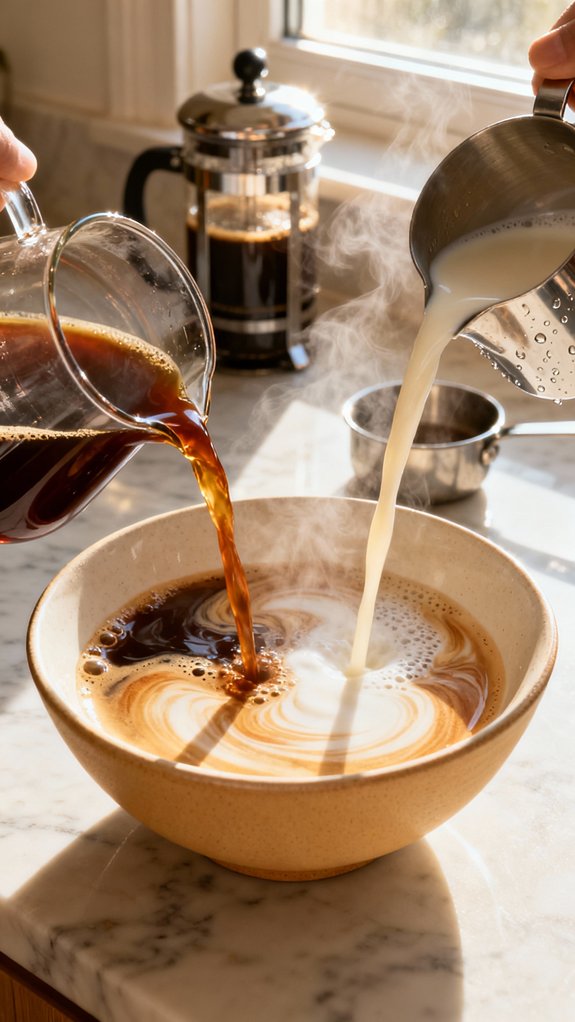
Once the coffee and milk are both ready and steaming, I grab the coffee in one hand and the small saucepan of milk in the other, positioning them both over my wide ceramic mug.
Then I pour them simultaneously, watching the two streams meet and swirl together in this beautiful light brown color. It’s like watching cream dissolve into coffee, except you’re controlling both sides. I aim for equal amounts of each, filling the mug about three-quarters full.
The milk’s foam naturally rises to the top, creating a thin layer that reminds me of cappuccino but lighter. Sometimes the pour gets uneven and I end up with more coffee than milk, but honestly, it still tastes great either way.
Step 5. Serve in Wide Bowl
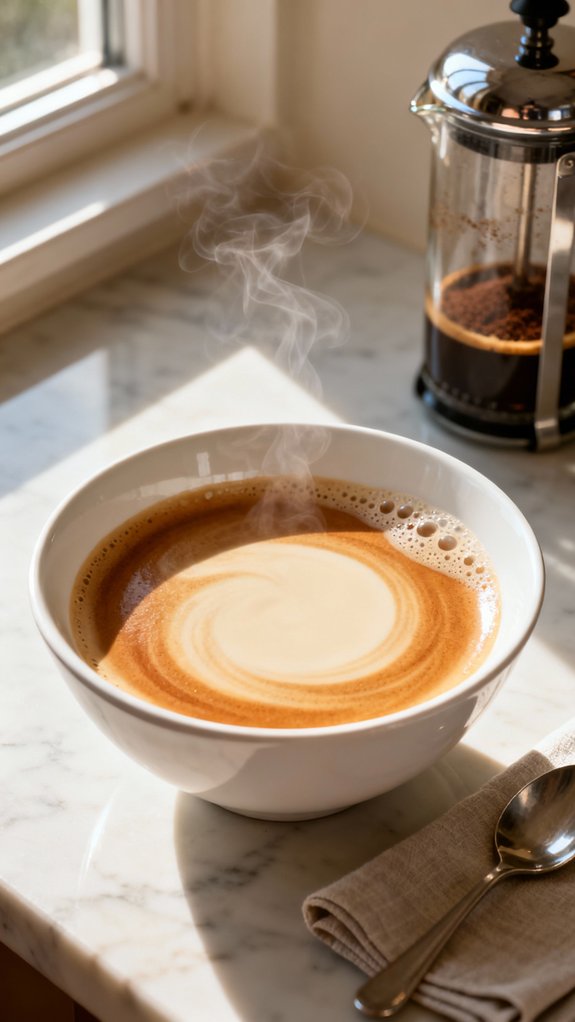
The traditional French way to serve café au lait is in a wide, shallow bowl instead of a regular mug, and I’ll admit it felt strange the first time I tried it.
But once you wrap both hands around that warm bowl, you’ll understand the appeal. The wide opening releases all those coffee and milk aromas right to your nose while you drink.
Plus, you can dunk your croissant or toast without it hitting the sides of a narrow cup.
Pour your finished café au lait into a bowl that holds about 16 ounces total. Leave a little room at the top so you don’t spill when lifting it.
The bowl should feel warm but not too hot to hold comfortably.
Final Thoughts
I’ve been making café au lait for years now, and it’s become my go-to morning drink when I want something comforting but not too heavy.
There’s something satisfying about the simplicity of it. You don’t need fancy equipment or barista skills to pull off a really good cup. Just strong coffee, warm milk, and maybe a touch of sweetness if that’s your thing.
I usually make it on Saturday mornings when I’m not rushing out the door, sitting at the kitchen table with the newspaper spread out in front of me.
It pairs perfectly with buttered toast or a muffin. The gentle coffee flavor won’t overpower your breakfast, which I appreciate.
Give it a try next weekend.
Frequently Asked Questions
What Is the Difference Between Café Au Lait and a Latte?
Unlike lattes, which leverage espresso, you’ll find café au lait uses drip or French press coffee combined with steamed milk. This creates a milder, more mellow flavor that’s less intense than espresso-based drinks.
Can I Make Café Au Lait Without a Milk Frother?
Yes, you can! Simply heat the milk in a saucepan until steaming, then whisk it vigorously by hand to create some foam. You’ll still get a delicious café au lait with nice texture.
What Type of Coffee Beans Work Best for Café Au Lait?
You’ll want medium-roast beans with balanced flavor, as they complement milk without becoming bitter. French roast or Colombian beans work excellently. Avoid light roasts since they’re too acidic, and dark roasts can taste overly harsh.
How Many Calories Are in a Typical Café Au Lait?
You’ll consume about 120-150 calories in a typical café au lait made with whole milk and sugar. For instance, your morning cup with 8 ounces of whole milk and a tablespoon of sugar totals approximately 135 calories.
Can Café Au Lait Be Served Cold or Iced?
Yes, you can serve café au lait cold or iced! Simply brew strong coffee, let it cool, then pour it over ice with cold milk. It’s invigorating and maintains the classic equal-parts ratio perfectly.